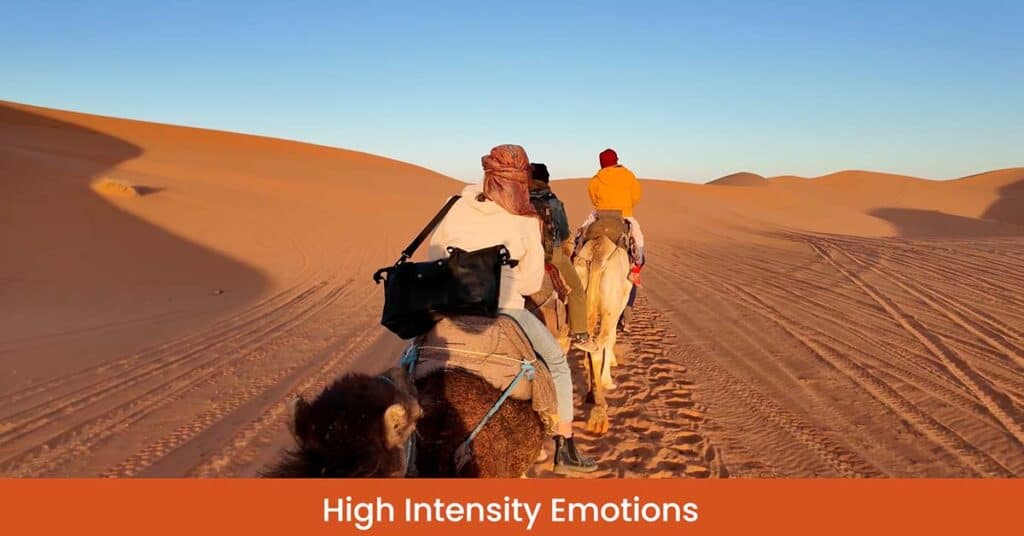
If a desert caravan is not your idea of a positive adventure, if it’s more a long haul pain than a longterm gain, transform your scene to find your best path.
Overview of Guiding Metaphors
NOTE: The introduction is the same for each of the four intensities of the Guiding Metaphors. If you have already read it, you may want to click to skip.
When you’re having emotions, do you talk about containing things? Are you erupting? Are things oozing out of you? Are your emotions overflowing? If so, you’re using container metaphors.
Maybe you see life as an expedition, or you want a tour around something. You want to take a trip down memory lane. You’re going to cruise through that stop sign. You want to explore that idea more. Let’s take a jaunt into the past. These are more vacation kinds of metaphors.
Do you use more meditative metaphors? Have you been stargazing at somebody famous? Are you guided by your imagination? Do you feel the connection toward people? Are you a dreamer?
Your emotions present as images and metaphors. Each week I explore new imagery, always looking at it from four levels of emotional intensity: extreme, high, medium, and low.
This week I’m doing it a bit differently: I’m looking at the concept of guiding metaphors, the words you use without even thinking about it, but that actually guide how you see the world. And those words create images in your mind – and in someone else’s – for how intense your emotions are.
Four Emotion Intensities with Four Guiding Metaphor Images
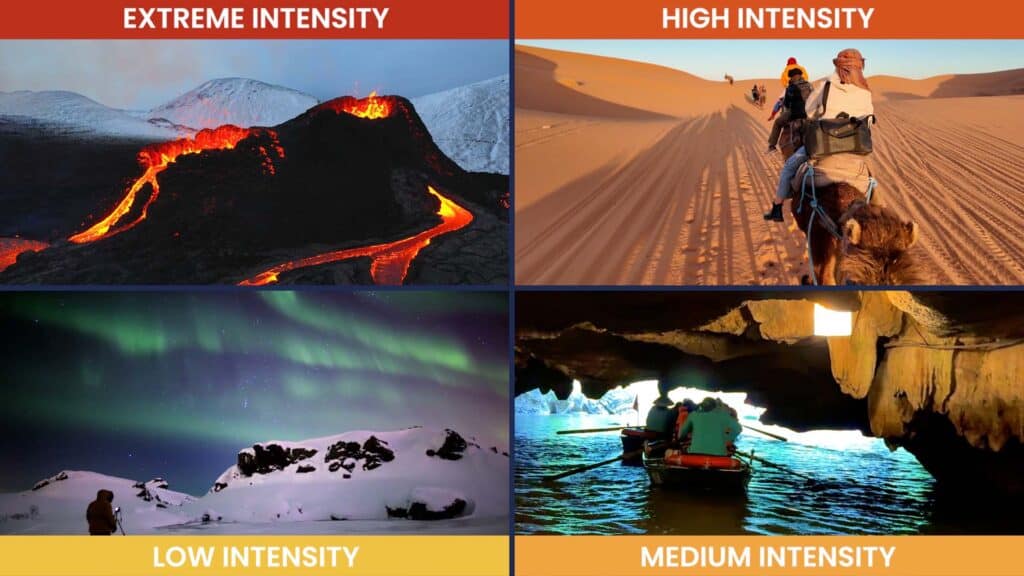
For example, if you had a smile on your face and were deeply in love, and said you were overflowing with emotions, I wouldn’t come up with this extreme intensity volcano image; however, I might come up with this image if you talked about your overflowing rage.
If we’re in high intensity negotiations, and you said “we’re in for the long haul,” I might interpret that as this image of a caravan crossing the desert. Meanwhile, you might be thinking of fifty truckers driving across the highway. We’re having the same high intensity emotions, but how we describe it is completely different.
For medium intensity emotions, we might be a married couple, and you’re saying you’re bored, we need to explore life more. But what that means to you is some version of this river cruise imagery; what it means to me is standing on top of Mount Kilimanjaro.
For low intensity emotions, you might tell me that I’m a daydreamer. The image that comes to mind for me is the aurora borealis: beautiful; enchanting. The image that comes to mind for you is disconnected and not doing my work!
Guiding Metaphors: Your Words Matter
Now, see how your emotions change when we change the wording. For extreme intensity, I talked about that volcano overflowing. But what if it’s oozing?
For high intensity emotions, is this a caravan or an odyssey? An expedition, or in for the long haul?
That medium intensity river cruise: Is it a tour? A trip? Are you exploring? Is it a jaunt?
And the aurora borealis: Are you dreaming that you’ll get there one day while the stars guiding you? Are you connected to them?
Your emotions present as images and metaphors. If you’re having negative emotions, and you want to transform your emotions, focus on your images.
- Extreme intensity emotions are going to feel wrapped up in your body.
- High intensity emotions, you’re going to be feeling a direct impact.
- Medium intensity emotions, you’ll be starting to feel the pressure.
- Low intensity emotions, you’ll be keeping things at bay.
The Desert Caravan: High Intensity Emotions
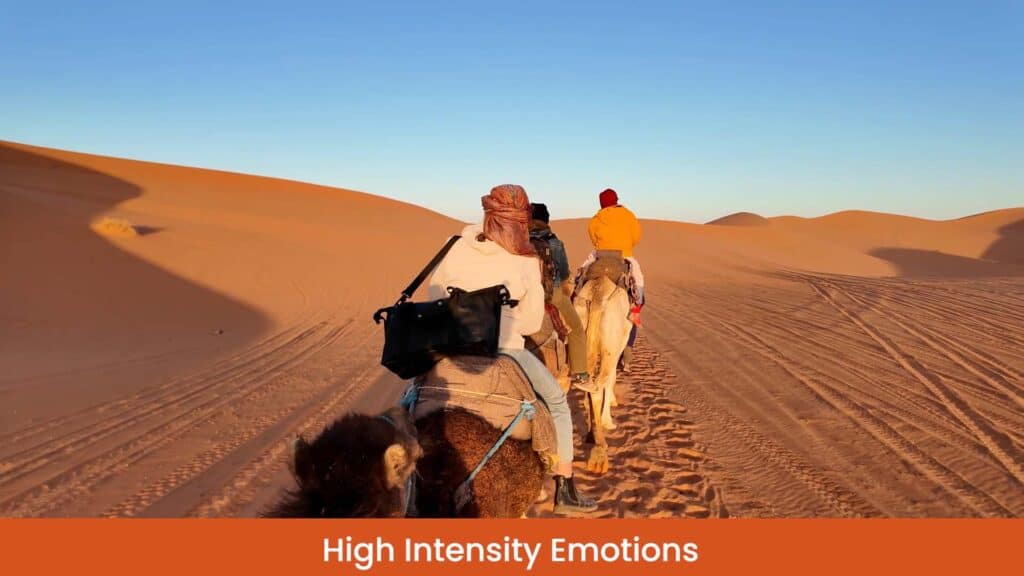
In this high intensity image, you’ve settled in for the long haul. But is that actually your best decision?
If you’re looking at this image as a high intensity emotion and it feels healthy to you, then you wouldn’t transform it; you’d see yourself more as part of a caravan on a journey that you’re wanting to be on. If, however, you’d much prefer a scene with more greenery, and what you’re seeing here is heat, desert, potential sandstorms, and an uncomfortable camel ride, all of this would say you’re having high intensity emotions about whatever your situation is, and you need to transform it – you don’t actually want to be a part of this caravan.
Transforming the Caravan: A Starting Place
Begin by locating your emotions in your body. There’s a difference between locating your emotions and locating where, in this image, you would be feeling the pain. So for example, my emotions, I’m feeling a whole body exhaustion from the heat of the desert; I’m not feeling the specific pain of sitting on a camel.
That camel imagery came out of me locating my emotions in my body, and describing what those emotions felt to me at this moment. So clearly, I don’t want to be part of a caravan; I don’t want to be in the desert. I want greenery around me. I want a sense of life around me.
And I don’t want to be single file – I want to transform that part of the image. I want to be part of a group working together.
The Desert Caravan: Transformation Example
So the first thing I want to do is just imagine greenery, trees, growing plants growing all around me, replacing the desert. I want to imagine the trees are giving me some shade, so there’s a place to cool off, and I want to imagine stepping off that camel.
Next, I want to look at all of the people that are in this caravan. This part of the imagery matters to you: This could be a line of strangers; it could be friends; it could be coworkers. You have to transform it in a way that feels healthy to you in this moment.
That doesn’t mean everybody is like you. It means that it’s a productive or healthy group to be with. So ask yourself, is being single file, following other people in front of you, the healthiest image for you?
It’s not for me. I want to imagine that the people I want to be with, that are healthy and productive with me, are in my group, hanging out under a tree, while everybody else just simply vanishes.
Let Your Imagination Lead You To A Calm Place
You can allow your imagination to do that. Your imagination is that link between your emotions and your intellect: Don’t get caught up in how you transform the imagery. As long as it feels healthy in your body, for whatever your issue is right now.
So my transformation is greenery everywhere, sitting with a group of people I want to be with, under the shade of a tree. There’s no desert in sight. The camels are gone. And the people that I don’t know or don’t need to have, at least for this decision, are no longer in the picture.
I take a few deep breaths, let them out slowly, and see if there’s anything else I need to transform in my new imagery. For me, there isn’t, so I’m ready to make my healthiest decision or take my next best step.
Make sure, when you’re doing your own transformations, that your final place is calm and positive and relaxed throughout your body.
Guiding Metaphors: Closing
That’s a quick look at the concept of guiding metaphors. You can learn more – there’s a full chapter on them in my book, Emotion Commotion. The key point is that the words you use matter. They tell you what your emotions are, and if they’re positive or negative. If you go to the next step and describe the imagery that those words bring up, you’ll get a lot more insight into your emotions.
You’ll also learn that the same words bring up different imagery and different intensities of emotions for somebody else than they do for you. And that can give you a starting place for better conversations.