Your body is tensing; you don’t want to keep moving. Is it a hard place because it’s the wrong direction, or because fear and anxiety are holding you back?
Overview of The Metaphor "Between A Rock and A Hard Place"
NOTE: The introduction is the same for each of the four intensities of the Between A Rock and A Hard Place metaphor. If you have already read it, you may want to click to skip.
So you finding yourself between a rock and a hard place. But what does that imagery actually look like for you, and how might you transform it to get yourself out of that situation?
Hello and welcome! My name is Karen, and this series is sponsored by Emotion Commotion and The EAT Program™. In these videos, I help you Locate, Describe & Transform™ the emotions that interfere with you making your best decisions.
Your emotions present as images and metaphors, so each week, I explore a new metaphor. always looking at it from four levels of emotional intensity: extreme, high, medium, and low. This week you’re between a rock and a hard place.
Between A Rock and A Hard Place: Four Emotion Intensities with Four Metaphor Images
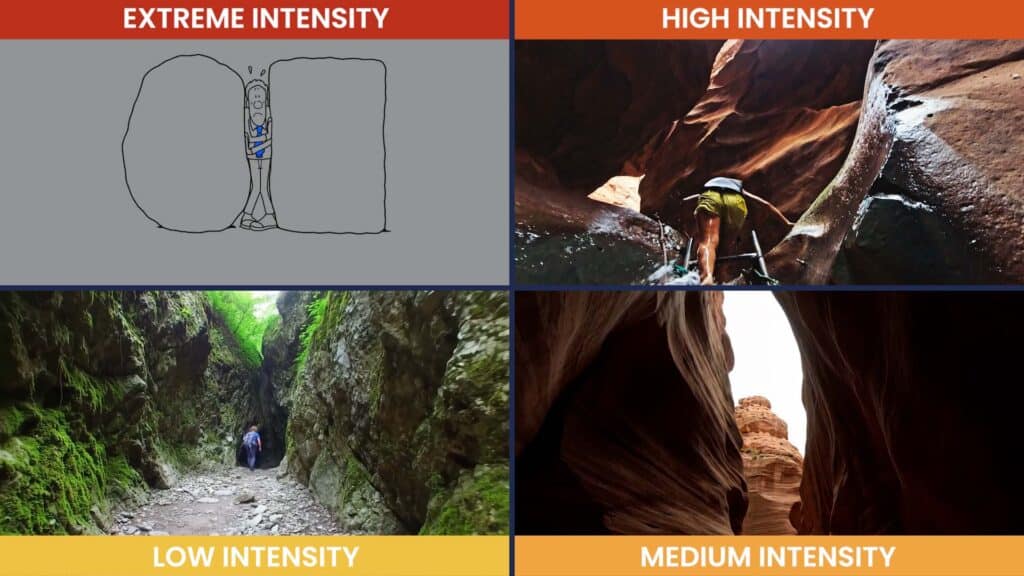
- For the extreme intensity video, I’ve chosen a sketch of somebody being squished between a rock and a hard place.
- For high intensity emotions, I’ve chosen a video of somebody climbing a ladder that is secured to rocks within a narrow space, but going up through a waterfall that’s crushing down on them.
- For medium intensity emotions, you’re walking at the base of a canyon that’s quite narrow, and the canyon walls are quite tall.
- And for low intensity emotions, you’re on a path with the walls closing in, heading into a narrow crevice.
If we make the assumption that the high, medium, and low intensity images are not fun activities for you – they’re actually metaphors describing negative emotions – let’s see how we can transform them into something positive.
Between A Rock and A Hard Place: Medium Intensity Emotions
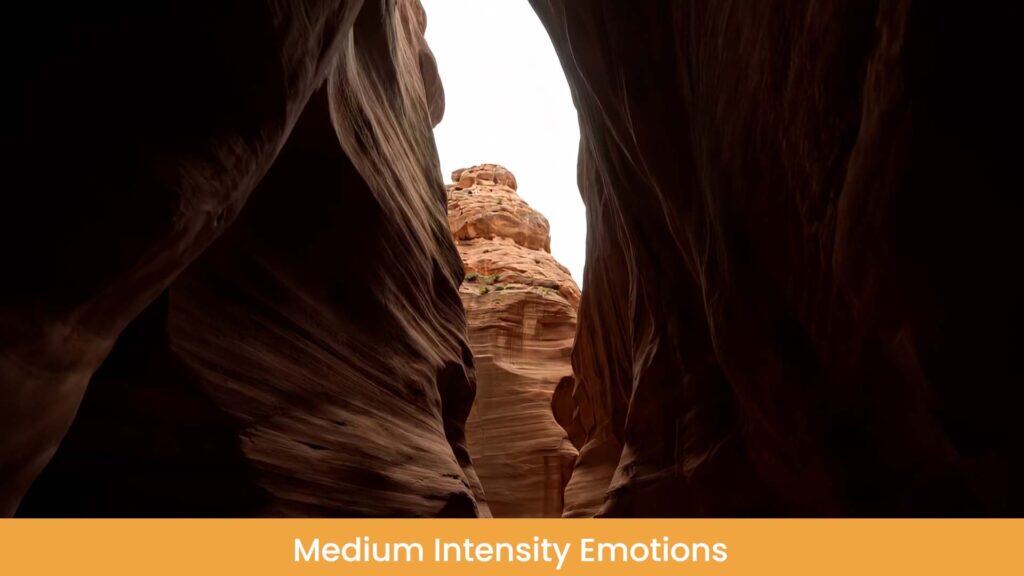
In medium intensity emotions, you’re starting to feel the pressure. We’re working with the metaphor between a rock and a hard place, but in this particular image, you could actually even use the metaphor, the walls are closing in. And each of those two phrases would come up with different emotions, different intensities, and speak to completely different situations.
Here’s what this imagery means to me.
The canyon walls are beautiful. I’ve been enjoying “the hike” so far in real life. Translation, that means I’ve been liking the path that I’m on. It’s felt good, but we’re coming to a narrowing in the walls, and that’s not feeling positive to me.
I don’t want to continue going forward. Now, you may feel like you can go forward, and you’re willing to turn sideways; my body is tightening up, especially in my chest and my throat, and the thought of going forward doesn’t feel healthy for me.
A Hard Place To Be: Transformation Example
I imagine turning myself sideways and going through the rocks, shuffling sideways: That feels even more negative. So I know the healthiest transformation for me is to go backward.
When I imagine myself doing that, I’m very quickly, within a few steps, in an open space that I’m very comfortable in.
At this point, I imagine sitting still, and I want to ask myself:
“Am I comfortable because I know this space, or am I comfortable because it’s the right space to be?”
Is It A Hard Place Only Because You're Afraid?
Sometimes our bodies can trick us – we don’t want to try a new adventure, try a new job, go in a new direction, take a new course – because we’re afraid. We cannot even be aware of that fear, but it’s taken over our body. We’ve just gotten so used to feeling that level of stress or anxiety that we don’t recognize it anymore.
So I want to take a moment to make sure that’s not what’s happening. And for me, it’s not. That tells me that whatever situation is on my mind – whether it’s a work direction, a friends’ direction – whatever it is, I was comfortable. Everything was positive and healthy for me up until a few steps back.
I want to take myself back in my mind – to what happened a few days ago, a few minutes ago – to how I might have acted or reacted, or what somebody else might have said or done, that I want to address. And from this new, grounded place, with my emotions transformed, I want to come up with my healthiest next step.
Between A Rock and A Hard Place: Closing
I’ve just presented four different scenes that represent four different intensities of emotion, but there’s another aspect you can look at as well. Once you describe your scene, it can also tell you how complex your emotions or the situation is.
Our extreme intensity image: If that represents our emotions, there’s no complexity at all to it. It’s one person squished in the rocks. Potential complexity comes with the hand that was drawing it if it wasn’t yours.
For the high intensity image, the complexity comes from the waterfall. And that complexity increases whether that waterfall represents one person or a group of people. Complexity [also] comes from the ladder, and complexity comes from the various rocks in the narrow path you have to climb out of. So this could be a high to extreme complexity situation that you have to manoeuvre.
In the medium intensity image, the complexity is probably in that medium zone: There doesn’t seem to be anything else but the rocks, and there is a way out. When I’m in there, I’m feeling like I’m alone, so complexity would be low [unless I needed assistance to get out].
And in the low intensity image, that’s probably a higher complexity. You can divide your complexity into low, medium, high, and extreme: Because the rocks are jagged; because it’s one path with rocks on it; because you’re going into a cave that you can’t see anything – that would increase the complexity.
The reason complexity can matter for you is it helps you to see how many different issues, how many different people, are involved in the situation that you need to transform.
So as you transform your image – you transform one aspect – it might actually represent a way for you to transform one particular aspect of your situation. For between a rock and a hard place, I’ve given you four examples of imagery.
Take a breath yourself when you’re feeling emotions. Locate the stress or tension in your body. Describe your metaphor as detailed as you can, and Transform that imagery to get yourself out from being between a rock and a hard place.

I respectfully acknowledge that this video was recorded on the traditional territory of Mi’kmaq people.
For more information on transforming negative emotions with Locate, Describe & Transform™ – LDT™ – go to theEATprogram.com.