
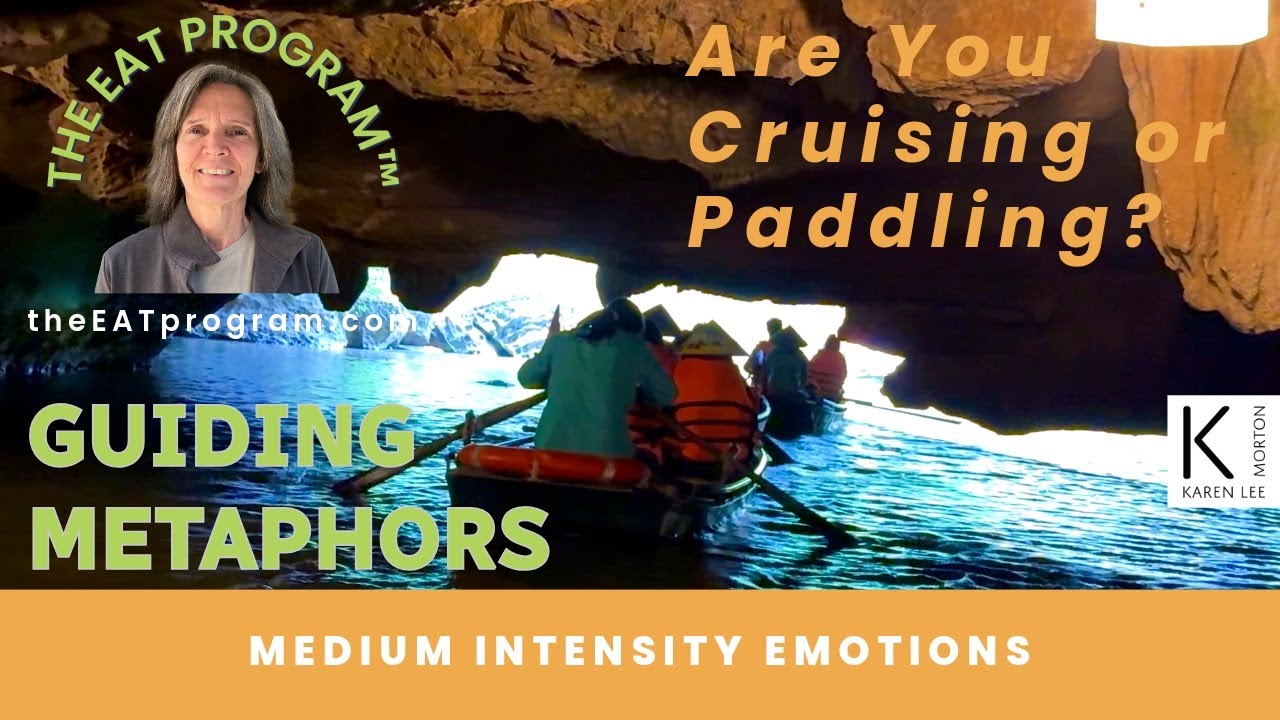
Your river cruise imagery is mainly positive, but you can’t help but notice that while the majority are cruising through life, someone has to paddle the boat.
Overview of Guiding Metaphors
NOTE: The introduction is the same for each of the four intensities of the Guiding Metaphors. If you have already read it, you may want to click to skip.
When you’re having emotions, do you talk about containing things? Are you erupting? Are things oozing out of you? Are your emotions overflowing? If so, you’re using container metaphors.
Maybe you see life as an expedition, or you want a tour around something. You want to take a trip down memory lane. You’re going to cruise through that stop sign. You want to explore that idea more. Let’s take a jaunt into the past. These are more vacation kinds of metaphors.
Do you use more meditative metaphors? Have you been stargazing at somebody famous? Are you guided by your imagination? Do you feel the connection toward people? Are you a dreamer?
Hello, my name is Karen, and in this series I help you Locate, Describe & Transform™ the emotions that interfere with you making your best decisions. Your emotions present as images and metaphors. Each week I explore new imagery, always looking at it from four levels of emotional intensity: extreme, high, medium, and low.
This week I’m doing it a bit differently: I’m looking at the concept of guiding metaphors, the words you use without even thinking about it, but that actually guide how you see the world. And those words create images in your mind – and in someone else’s – for how intense your emotions are.
Four Emotion Intensities with Four Guiding Metaphor Images
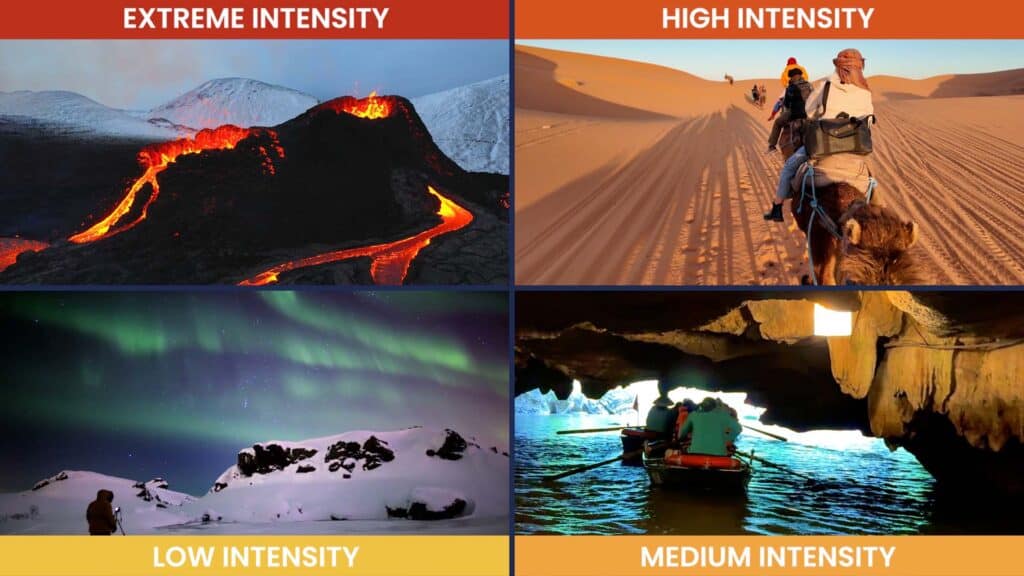
For example, if you had a smile on your face and were deeply in love, and said you were overflowing with emotions, I wouldn’t come up with this extreme intensity volcano image; however, I might come up with this image if you talked about your overflowing rage.
If we’re in high intensity negotiations, and you said “we’re in for the long haul,” I might interpret that as this image of a caravan crossing the desert. Meanwhile, you might be thinking of fifty truckers driving across the highway. We’re having the same high intensity emotions, but how we describe it is completely different.
For medium intensity emotions, we might be a married couple, and you’re saying you’re bored, we need to explore life more. But what that means to you is some version of this river cruise imagery; what it means to me is standing on top of Mount Kilimanjaro.
For low intensity emotions, you might tell me that I’m a daydreamer. The image that comes to mind for me is the aurora borealis: beautiful; enchanting. The image that comes to mind for you is disconnected and not doing my work!
Guiding Metaphors: Your Words Matter
Now, see how your emotions change when we change the wording. For extreme intensity, I talked about that volcano overflowing. But what if it’s oozing?
For high intensity emotions, is this a caravan or an odyssey? An expedition, or in for the long haul?
That medium intensity river cruise: Is it a tour? A trip? Are you exploring? Is it a jaunt?
And the aurora borealis: Are you dreaming that you’ll get there one day while the stars guiding you? Are you connected to them?
Your emotions present as images and metaphors. If you’re having negative emotions, and you want to transform your emotions, focus on your images.
- Extreme intensity emotions are going to feel wrapped up in your body.
- High intensity emotions, you’re going to be feeling a direct impact.
- Medium intensity emotions, you’ll be starting to feel the pressure.
- Low intensity emotions, you’ll be keeping things at bay.
Cruising Through Life or Medium Intensity Emotions?

For the medium intensity video, I actually feel like I’m the person rowing the boat. If you had asked me what my emotions were, and I came up with this image, it’s because I feel like everybody else is cruising along and I’m doing the work, and I’m starting to feel the pressure from that. So I want to transform the image in a way that has everybody contributing to the ride.
Your interpretation can be completely different. You might be feeling pressure from not doing enough work. You might be feeling the pressure of being out on a vacation when you want to be doing work.
Whatever it is for you, you want to locate it in your body; describe your image; and transform it in a way that makes you feel the healthiest. Since it’s a medium intensity emotion, I’m only just starting to feel the pressure: I’m going to transform my image so that I can transform my situation before it gets out of hand.
If You Aren't Cruising Through Life, Here's A Transformation Example
I’m actually enjoying the cruise that we’re on. This image, to me, speaks to a work situation where I’m enjoying working with the people, I’m enjoying the project we’re on, I just feel like maybe I’m taking on a little bit more than they are.
Then, as I say that, it comes to me that maybe they think I’m taking on more and not giving them enough. So I just want to balance this out.
A simple transformation: I imagine all of us in the boat having oars.
Just like that, my body relaxes. I feel the relaxation most in my throat, where I wasn’t speaking up, and in my stomach, where I wasn’t even aware that I was carrying stress.
LDT™: Start Feeling Like You're Cruising Through Life
This is an example using LDT™ where it doesn’t always go in that order: Locate, Describe & Transform™. This would be an example where I came up with an image to describe my metaphors, and in describing that metaphor and transforming it, then the body location came up.
We get so used to carrying stress in our bodies that we aren’t even aware of it a lot of the time. It can take us going through this kind of a transformation process with our imagery to start to connect more with our body and realize where we’re carrying the tension.
So I’ve transformed this river cruise in a way that feels healthy for me. I’m quite comfortable going into the caves and coming out into the wider river; I like the scenery; it feels like a positive adventure to me.
If it does not feel like that to you, if you came up with this image and need a complete transformation, as I did with the high intensity image of the caravan, then make sure to transform the imagery in a way that feels healthiest for you. Your final goal is to be able to go back with the group and work well together.
Guiding Metaphors: Closing
That’s a quick look at the concept of guiding metaphors. You can learn more – there’s a full chapter on them in my book, Emotion Commotion. The key point is that the words you use matter. They tell you what your emotions are, and if they’re positive or negative. If you go to the next step and describe the imagery that those words bring up, you’ll get a lot more insight into your emotions.
You’ll also learn that the same words bring up different imagery and different intensities of emotions for somebody else than they do for you. And that can give you a starting place for better conversations.

I respectfully acknowledge that this video was recorded on the traditional territory of Mi’kmaq people.
For more information on the Locate, Describe & Transform™ – LDT™ – process, go to theEATprogram.com.