
Balancing Act 101: When you realize the stress you’re trying to balance isn’t even yours, it’s time to let it go. Give this “bright light bubble” idea a try.
Overview of The Emotions Metaphor "Balancing Act"
NOTE: The introduction is the same for each of the four intensities of the Balancing Act metaphor. If you have already read it, you may want to click to skip.
Hello, my name is Karen and in this series I help you Locate, Describe & Transform™ (LDT™) the emotions that interfere with you making your best decisions. Each week I explore a new metaphor. If you want more details on my process, check out the short process video.
This week’s metaphor is BALANCING ACT, which I think is something we can all relate to.
Four Emotion Intensities with Four Balancing Act Images
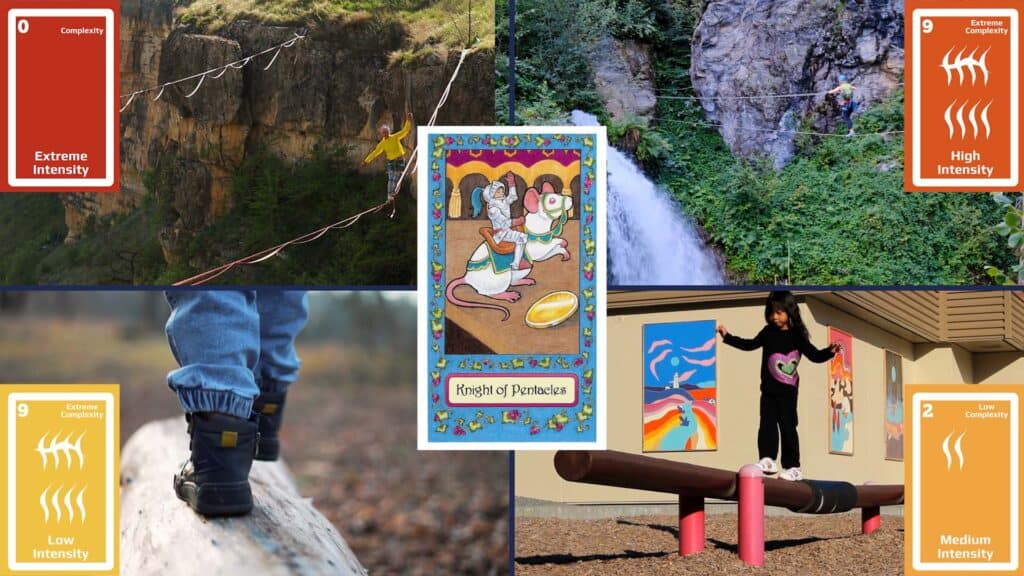
- For extreme intensity emotions, I chose a very flexible wire high up on canyon walls with the person crossing, not holding on to anything with their hands, although they do have a security rope around them.
- For high intensity, I chose a more stable cable wire with somebody using their hands on other cables to walk across the chasm.
- For medium intensity, I chose a series of connected logs on a child’s playground that are only a couple of feet off the ground, but that move as you walk on them.
- And for low intensity, I chose a log that is solid right on the ground.
As always, a reminder: If you connect with the balancing act metaphor, but your imagery is completely different, consider closing your eyes, working with your own imagery to Locate, Describe & Transform™ your negative emotions.
The Complexity Cards
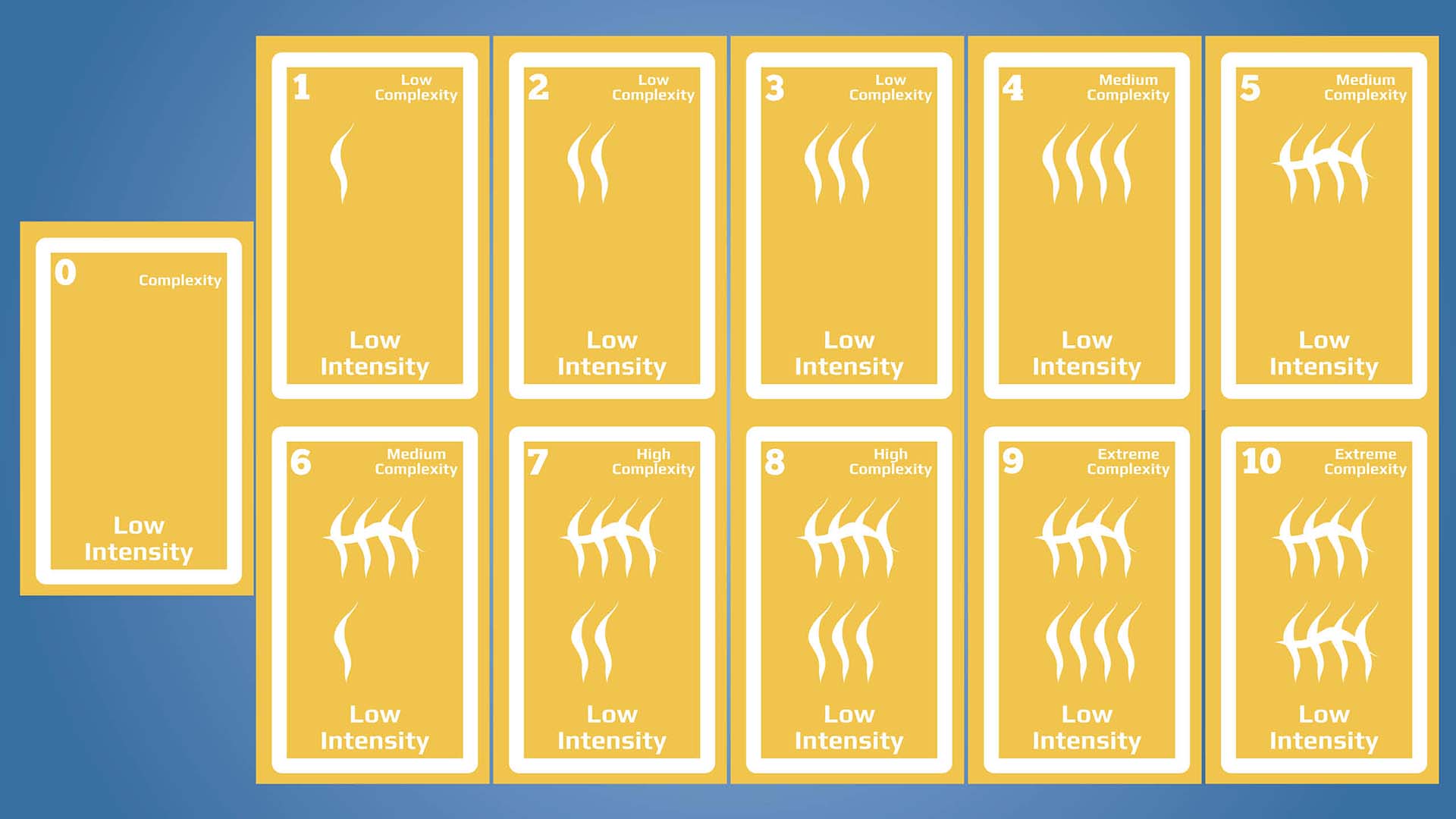
For each of the emotional intensities, there’s a complexity card:
- For extreme intensity, the complexity is zero. That means whatever the situation, whatever your emotions, it involves only you and only one particular aspect of something.
- For high intensity, it’s actually extreme complexity.
- For medium intensity, it’s a low complexity card.
- And for low intensity, it’s an extreme complexity card.
Tom Thumb: The Character from The Whimsical Tarot Deck
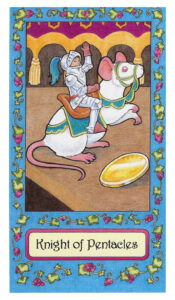
In the centre of the layout is a Whimsical Tarot card: the fairy tale is Tom Thumb; the tarot card itself is the Knight of Pentacles. Now, Tom Thumb is a bit before my time, but I do remember my grandparents telling me that story. Tom Thumb is shown riding on his mouse as part of King Arthur’s Knight of the Round Table on the tarot card, and the origin of the story is a wish from a fairy queen grants a poor couple a son as small as a thumb. The child is courageous, clever, and resourceful at overcoming real world limitations.
In Tom’s case, it’s physical; the Knight of Pentacles generally is speaking toward your finances. So we’re going to be looking at the balancing act with respect to your financial situation, looking towards balancing well-researched plans to get the results that you desire; taking a moment to look at the big picture, but then carefully checking every detail. That’s what’s going to bring you into balance.
So, as we explore the imagery and the complexity cards, consider a practical plan for bringing balance to your finances and or specific projects you might have in mind.
Balancing Act: Low Intensity Emotions
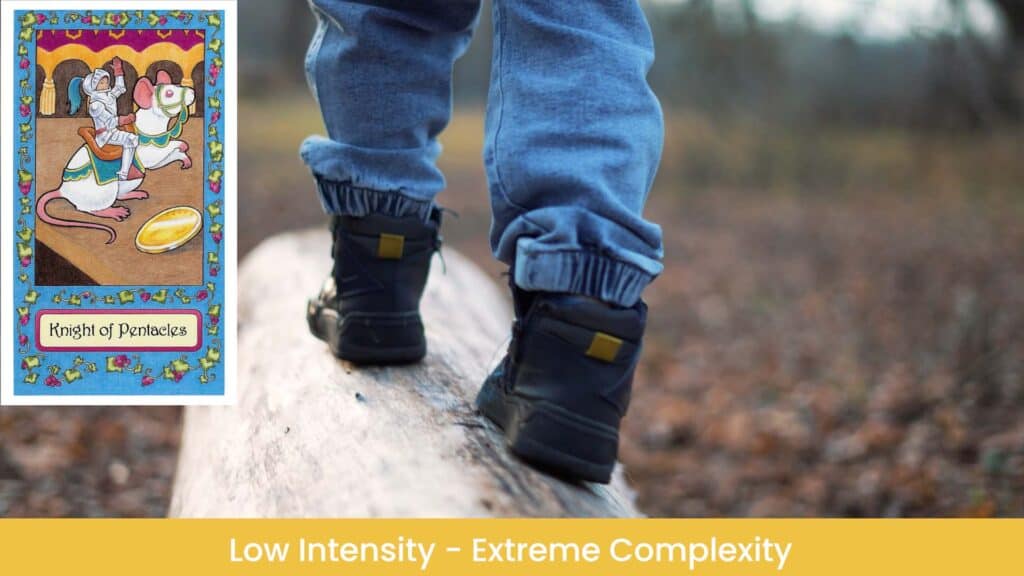
The low intensity video I picked was of a child where we see only the legs walking across a log on the ground. Interestingly, unlike the medium intensity image where I felt rather depressed and stuck – my emotions not yours – with low intensity, I feel a thrill. In this instance, this image is bringing me back to my childhood and reminding me of the fun new adventures that I had back then.
We’re working with extreme complexity. This was randomly chosen, but if I keep that in mind, that makes sense from my childhood because of the complexities I had with family, with moving, with making new friends, and so forth. So that’s my foundation for working with this image. If this image speaks to you, situate it however it works for you.
The low intensity is also about keeping things at bay, or seeing stresses or conflicts that just haven’t quite reached you yet; they’re out of your sight line. And that certainly speaks to this image for me, of seeing this child’s boots walking across a log.
Bright Light Bubble: Give Yourself A Safe Space
So I want to Locate, Describe & Transform™ any negative emotions I have related to the balancing act metaphor, low intensity, with this image. I put myself in place of that child, and what I’m feeling is almost a force field as I move forward – an energy, a stress energy, that I want to clear.
What this is telling me is the stress isn’t me; it’s the world I’m living in. So I want to put myself into a protective bubble, a healthy one that I can easily breathe in and out, that any positive, loving energy can come into me, but that bubble just continues to grow, to push that stress energy further away from me.
But Still, The Tension Increases
Interestingly, as I imagine doing that, I feel more tension, and not because I recognize that I’m trying to push that stress energy away, [but because] I have to keep myself healthy within that energy. That speaks to situations that you can’t get out of. Low intensity, we’re talking here, so, you know, it’s typical family stresses: If you have siblings, if you have relatives that you have to visit. We’re not talking anything extreme; it’s more of a mood.
So you have to feel safe and secure and healthy within that energy that you have to be, in but you can’t shift. For me, that’s that bright light bubble image where, you stretch out your arms as far as you can, reach them up high above your head, down into the earth. Just a protective space that says, “hey, I don’t want to be away from this, but there’s a little tension in the air that I’d rather not deal with.”
Transformation Example: Don't Carry It Forward
So if we bring that away from childhood and into adulthood, this could speak to a tension that you feel from childhood that’s not actually in your world right now, and that it’s something that you want to dissolve. And that’s the image I’m getting. So now that I’m back in my adult world, I’m looking at how I’ve unexpectedly interpreted this video and I’m saying, “hey, I’m not that child within that [financial] stress household that I couldn’t control. I’m an adult and I don’t need to carry that stress with me.”
And suddenly, I’m feeling within my body a pulsating, vibrating stress that I know I don’t need to carry around.
So what do I need to do to transform it? Because now we’re at the next transformation. The bubble was the first step; now, in this low intensity situation – I’m seeing why it’s extremely complex for me – I need to release this vibrating, pulsating, negative energy.
For me, being out in nature is a good thing, so this image works for that. I choose to jump off the log, walk toward the path, take a deep breath, put my arms out really wide, and just soak up nature. And because I love the sun, I love the warmth of the sun, I imagine that sun beaming down to my chest that’s wide open now, and just pulling out all of the negative energy and fear associated with finances.
If your interpretation of the video is completely different from mine, that’s great. Focus on what it means to you, what intuitively comes to you. Transformations of your emotions aren’t about thinking through things; they’re about a willingness to go with your intuition as new insights open up.
Closing
Last week, we looked at the leaning metaphor, and the caution within that was: Be careful, you might be leaning toward or away from something and not really noticing, and that the best position would be for you to straighten yourself up. This time, we’re looking at a balancing act metaphor, and I think the caution here is to recognize that balance does not mean equal distribution of everything all the time. Each of us finds our own balance.
So for me, surprisingly, once I started going through the process myself with each of these images as an example for you, I found that my healthiest balancing place was at the high intensity emotions. For you, it might not be: low intensity might be exactly where you want to be. But I found, for me, high intensity did not mean negative emotions, and that my healthy balance is a bit more toward adventure than it is toward security.
The focus, however, is still about being in balance, not putting one so far ahead of the other, so you’re clinging to security and not willing to go out and try anything new, versus you’re always flying by the seat of your pants, and you have zero security.
You will know that you are out of balance when you start to feel uneasy or discomfort in some part of your body.

I respectfully acknowledge that this video was recorded on the traditional territory of Mi’kmaq people
For more information on transforming negative emotions with the LDT™ process – Locate, Describe & Transform – check out theEATprogram.com.