You know you’re leaning in, and think it’s a healthy choice. But have you really chosen it, or are you just taking the easiest path? Here’s how to find out.
I respectfully acknowledge that this video was recorded on the traditional territory of Mi’kmaq people.
For more information on transforming negative emotions with the LDT™ process – Locate, Describe & Transform™ – check out theEATprogram.com.
Overview of The Emotions Metaphor "The Leaning Tower"
NOTE: The introduction is the same for each of the four intensities of the The Leaning Tower metaphor. If you have already read it, you may want to click to skip.
Hello, my name is Karen and in this series I help you Locate, Describe & Transform™ (LDT™) the emotions that interfere with you making your best decisions. Each week I explore a new metaphor, always looking at it at four levels of emotional intensity: Extreme; High; Medium; and Low.
If you want more information on the process I use, you can check out the short overview video.
This week’s metaphor is THE LEANING TOWER.
Four Emotion Intensities with Four Leaning Tower of Pisa Images
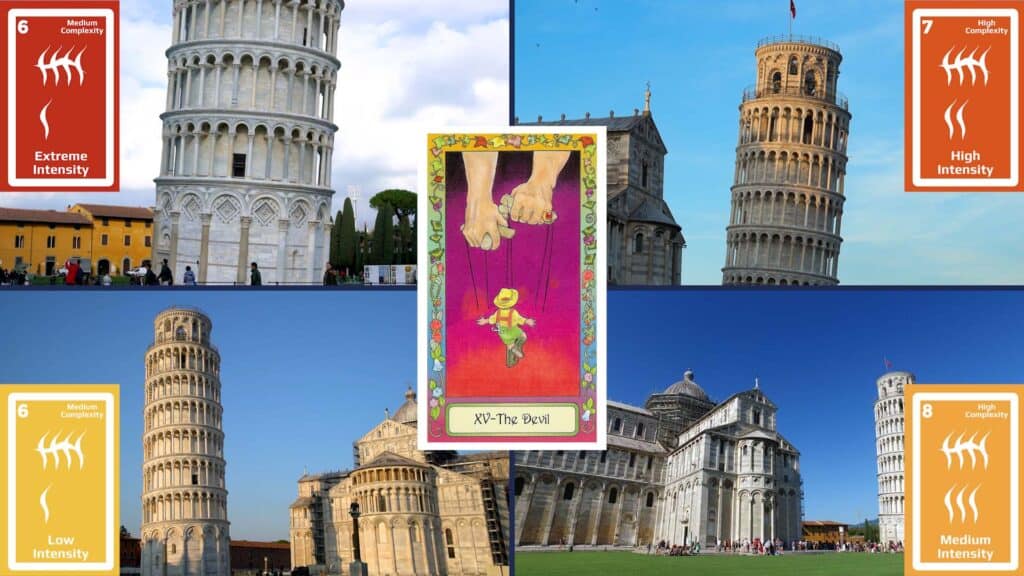
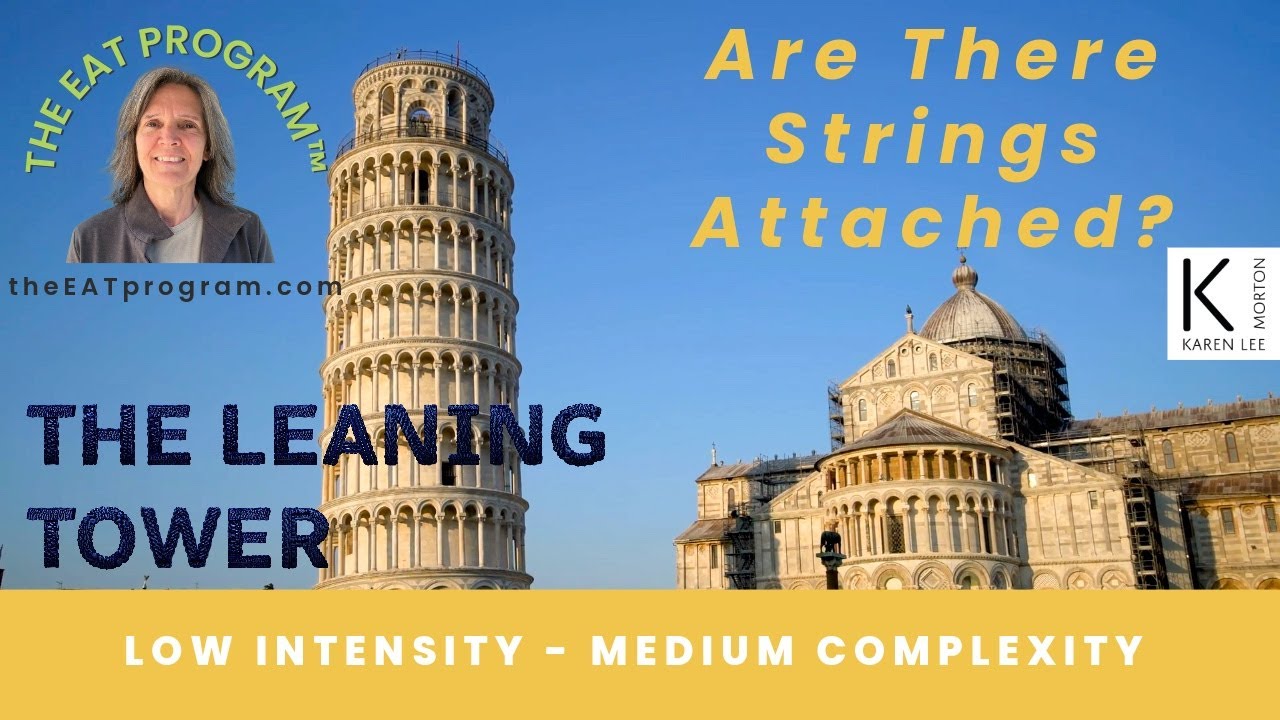
I’m focusing on the Leaning Tower of Pisa, looking specifically about things that you might be leaning toward or leaning away from, and how stable you are. We’re working with four different views of the same tower, and from four different distances.
- You are the tower, but in extreme intensity, your perspective is right up beside it. So your perspective might be leaning one way or another because you don’t have a big picture.
- In high intensity, there’s a bit more space. You’re seeing yourself a bit more objectively, and you’re very clearly seeing the lean that exists in your thinking or in your behaviours.
- In medium intensity, we have a more distant view still, and you can’t quite see the lean from a distance. It doesn’t seem like it’s quite so bad whatever direction you’re leaning in.
- From low intensity, there barely seems to be any lean at all, and you have a pretty faraway view of yourself and your circumstances to the emotional intensity.
The Complexity Cards
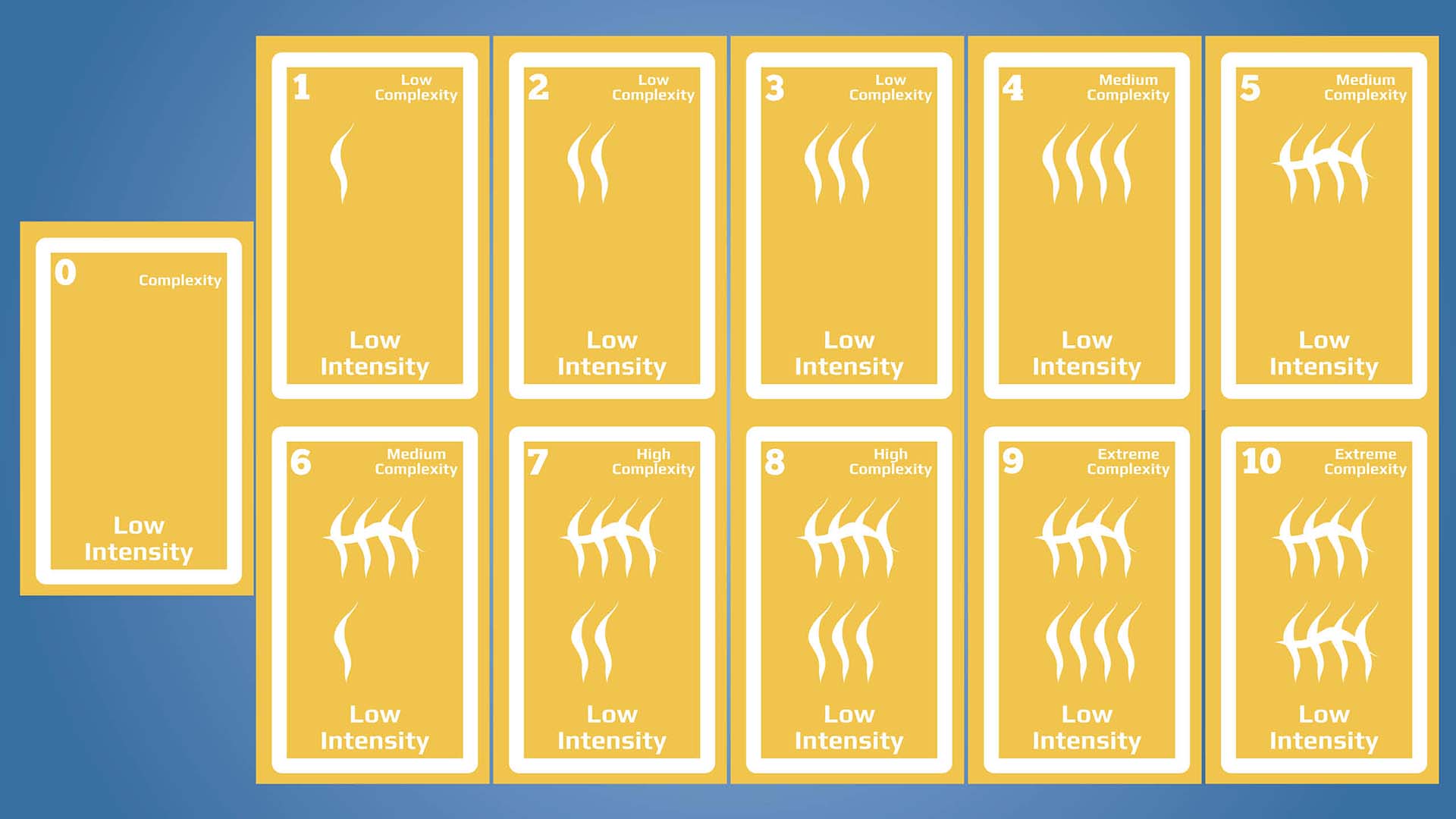
We add a complexity card, so
- The extreme intensity comes with a complexity of six.
- The high intensity comes with the complexity of seven.
- The medium intensity comes with the complexity of eight.
- The low intensity comes with the complexity of six.
Pinocchio: The Character from The Whimsical Tarot Deck
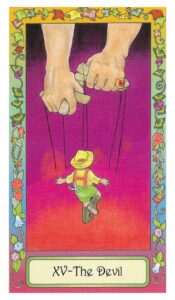
The randomly chosen whimsical tarot card is the Devil, and this is a fairy tale, Pinocchio, and the puppet master who’s controlling Pinocchio’s strings. Pinocchio is a living, breathing puppet made from wood that wants to become a real child. He often gets carried away by bad company. He’s prone to lying, and when he lies, his nose becomes longer. Pinocchio wants to have fun and is constantly rejecting any sense of responsibility.
So the puppet master controls the strings that move Pinocchio, and the Devil in tarot cards represents the limits we set for ourselves: the chains that we bind ourselves with; the mental weapons we use against ourselves to keep from getting ahead. So we’re basically holding ourselves hostage. We’re refusing to let go of fear. We’re holding on to desires. We’re showing a lack of initiative.
So we’re the puppet masters of ourselves. We’re the ones keeping our strings attached to limitation. So as we explore the scenes and the complexity cards, ask yourself, what have you bound yourself to? What are you leaning toward or leaning away from out of fear or negative emotions? And what’s the healthiest way to free yourself?
Leaning Away: High Intensity Emotions
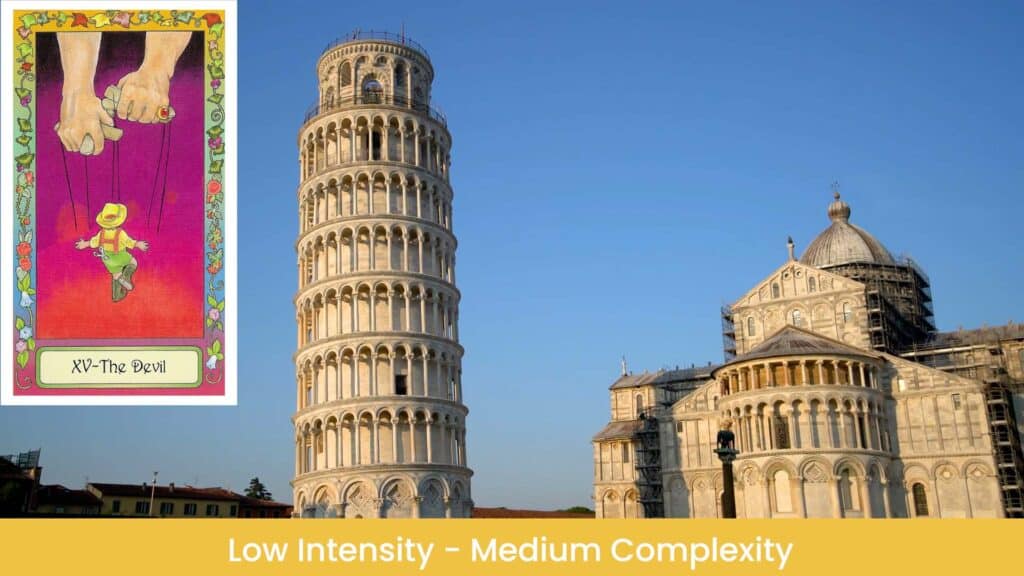
In this low intensity video, we see the Leaning Tower of Pisa not really showing that much of a lean. You could trick yourself into thinking it’s not leaning at all.
Low intensity emotions means you’re keeping things at bay. It could also mean that things are coming toward you, but you haven’t identified those stresses or conflicts yet.
So in this imagery, there’s not really a whole lot of stress or tension that you’re going to be feeling. That means one of two things: you either have puppet strings attached and aren’t aware of it; or you’re not really needing to move on. Even though those strings are there, they’re not controlling you so much.
In other words, you’re happy with the status quo. You’re aware of a connection that could at some point become unhealthy, but at this point you’re okay with it.
The question is, is that your head talking, convincing yourself you’re aware of it? Or are you feeling a negative emotion in your body that you should be listening to?
Transformation Example
For me, I’m not feeling that I need to move away, but I am feeling the need to say “I’m choosing to be here.” I don’t need the strings to keep me here, so I’m going to cut the strings.
I’m feeling that in my throat the most: I need to speak up. And with the medium complexity, I’m feeling like there are probably a couple of strings – two strings – and feeling that I need to cut free.
And I’m going to do that by first imagining disconnecting the strings. And I’m seeing them attached to my hands. So I’m just imagining that I’m loosening those strings, taking them off my hands. In the real world, what it means to me is I need to either say something, or stop being silent when somebody else says something.
[NOTE: The curiosity for me is that although I’m feeling it in my throat, the attachments are to my hands. I don’t need to rationalize this; just go with your transformations and don’t overthink them. Having said that, I do actually use my hands a lot when I speak!]
Remaining Alert to the Lean
And that thought just catapults me over instantly to the times that I might stay silent. When somebody says a bad joke, says a derogatory comment, comes up with some populist fake news statement, and I don’t respond.
So what I want to look at is, in advance of that happening, what might I say or do that makes it clear that I still am in that situation, I’m not running away from it – that’s the tower that’s staying right close to the building, it’s not choosing to leave – but I’m going to be my own person and use my voice in a healthy way.
The medium complexity speaks to me as neighbours, for example, where I want to get along with people while still speaking my truth, or at least defending if I think somebody has attacked somebody else in some way.
Now that’s a transformation that’s very specific to me. It’s specific to my focus on stress and conflict and human rights and diversity. Your interpretation is going to be different. Just know that in a low intensity situation, low intensity emotions, it’s going to be likely a minor shift that you need to do, not something major to transform your emotions and make your healthiest decisions or take your healthiest next steps.
Closing
I’m using the Leaning Tower of Pisa for all emotional intensities; your imagery could be completely different. If you find yourself leaning towards something or leaning away from something, look to:
- Locate in your body where your strongest emotion is.
- Describe it with your own imagery
- Transform that imagery so that you can straighten out that lean and make your healthiest decisions.