

You’re between a rock and a hard place because you’re swamped by someone else’s emotions. Take yourself into new territory and regain your personal space.
Overview of The Metaphor "Between A Rock and A Hard Place"
NOTE: The introduction is the same for each of the four intensities of the Between A Rock and A Hard Place metaphor. If you have already read it, you may want to click to skip.
So you finding yourself between a rock and a hard place. But what does that imagery actually look like for you, and how might you transform it to get yourself out of that situation?
Hello and welcome! My name is Karen, and this series is sponsored by Emotion Commotion and The EAT Program™. In these videos, I help you Locate, Describe & Transform™ the emotions that interfere with you making your best decisions.
Your emotions present as images and metaphors, so each week, I explore a new metaphor. always looking at it from four levels of emotional intensity: extreme, high, medium, and low. This week you’re between a rock and a hard place.
Between A Rock and A Hard Place: Four Emotion Intensities with Four Metaphor Images
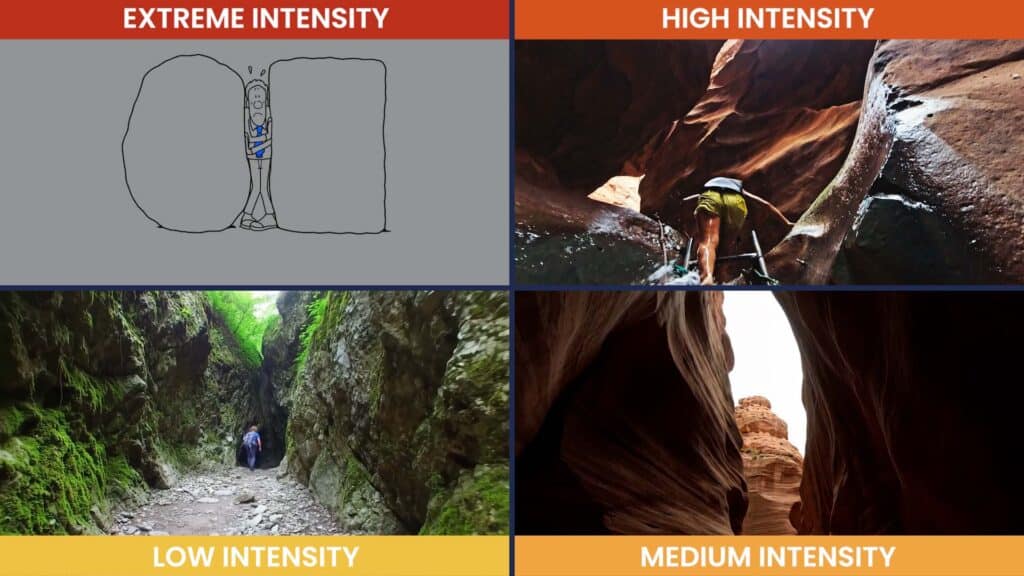
- For the extreme intensity video, I’ve chosen a sketch of somebody being squished between a rock and a hard place.
- For high intensity emotions, I’ve chosen a video of somebody climbing a ladder that is secured to rocks within a narrow space, but going up through a waterfall that’s crushing down on them.
- For medium intensity emotions, you’re walking at the base of a canyon that’s quite narrow, and the canyon walls are quite tall.
- And for low intensity emotions, you’re on a path with the walls closing in, heading into a narrow crevice.
If we make the assumption that the high, medium, and low intensity images are not fun activities for you – they’re actually metaphors describing negative emotions – let’s see how we can transform them into something positive.
Between A Rock and A Hard Place: High Intensity Emotions
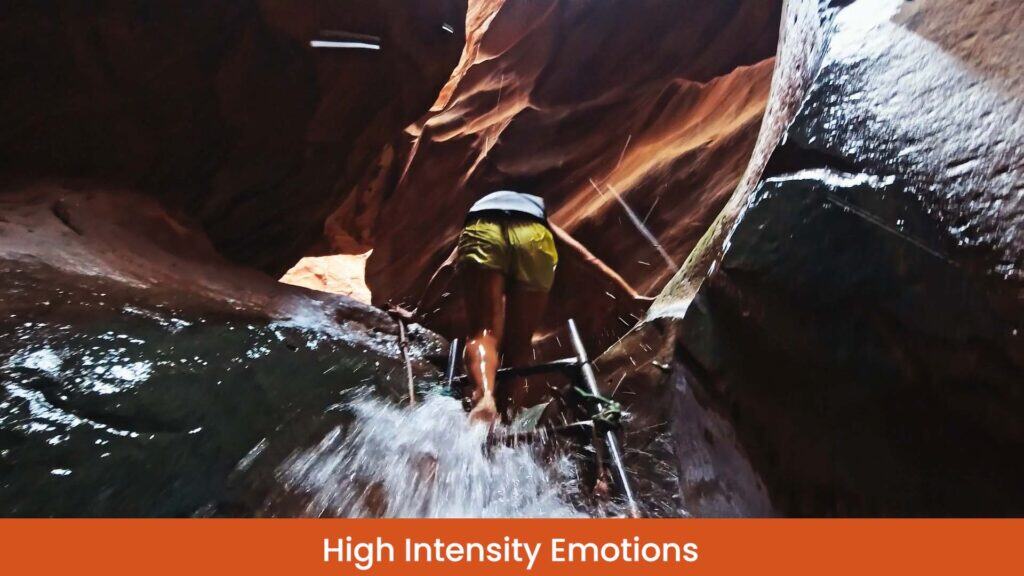
For high intensity emotions, you’ve said you’re between a rock and a hard place. But when asked, you come up with this image: rocks that you’re climbing out of; the ladder is secure, but it’s going up through a waterfall. Clearly, with the ladder there, others have gone before you: it’s doable, but it’s not where you want to be.
You can see how imagery can give you much more description than the mere words, “rock and a hard place”: I certainly wouldn’t have come up with this image if you had said those words to me. But if you’re coming up with this imagery, that level of detail helps you to transform your emotions much faster than if you’re just working with your words.
Here’s what the imagery says to me: It’s an adventure; some people enjoy it; you’re not having fun. You’re feeling a high intensity, negative emotion.
There’s nothing wrong with the activity itself; it’s just not the right choice for you. Whatever it is in your real life, it’s not what you want to be doing. To find out what path you want to be on, transform this imagery, get to a calm place, and a new image will come that better expresses what you want to be doing.
Swamped By Others' Emotions
My first transformation is to stop the waterfall. Water typically, in our imaginations, in our dreams, means emotions. And this is just a whole lot of emotion. And because you’re not liking the activity, negative emotion pouring down on you because you’re climbing the ladder, those emotions aren’t yours.
So you’re actually in a high intensity situation that you describe as being between a rock and a hard place, because you’re being swallowed up, swamped, poured on – whatever metaphor works for you – by somebody else’s emotions, or by a group of people’s emotions.
This kind of intensity works for them; it is absolutely not working for you, and you want to transform it.
Between A Rock and A Hard Place: Transformation Example
First things first, stop the water from falling down on you. Pay attention to your body: Imagine the water stops completely. Does that feel healthy, or does it make you feel more tense?
For me, I feel more tense in my stomach, like stomach knots are coming on. So we’ve moved from a rock and a hard place to stomach knots as my metaphor. I don’t like the stomach knots, so I don’t want to stop the water from falling. What that tells me is I like the other people’s emotions. I like how they’re getting into this project, or it’s a family dynamic, but I don’t want it landing on me.
So I try another transformation: I put up an umbrella as I’m walking up, and then I feel rejuvenated. I feel good, I feel like I can walk my path while having their emotions not land directly on me.
For my second transformation, once the umbrella is in place, I ask myself, “do I still want to climb up this ladder?” And the answer is no.
New Territory: No More Rock and A Hard Place
That’s an intuitive answer, and if I follow it, that means that I’ve been climbing up this ladder, trying to climb out from between this rock and a hard place. And that tells me that I’m trying to use the other person or group’s process or way of being or high intensity level of emotions as a way of living my life, or at least, in particular, working in this project, or whatever the situation is. And I don’t want to. That doesn’t make me feel good.
And as soon as I realize that, my body completely relaxes, and I walk out the back end, around the rocks, and go into completely open territory. And just by saying that, I’ve come up with a new, healthy metaphor for me, and that is going into new territory. And that new territory feels good to me.
It feels positive. It feels like I can breathe easy, and there’s lots of open space. That’s now the energy that I want to bring forward into the relationship dynamic, where before I was feeling stuck between a rock and a hard place.
A Bright Light Bubble of Personal Space
So with that original metaphor transformed, with my imagery having me holding an umbrella against other people’s emotions, and then walking out in a new direction, I can ask myself what real world steps I need to do to keep this level of calm within me.
The first thing I want to do is recognize, in advance, that I need personal space, and be able to take it. I also want to be able to create, in my imagination, a sense of personal space when I can’t get out of a situation.
I use what I call a bright light bubble. I just imagine a protective space around me, far beyond my hands, well above my head, down into the earth where I can breathe easy, where the negative energy coming toward me is slowed down or stopped – or the high intensity positive energy as well. Slowed down, stopped, so that I keep my own sense of a safe personal space.
Going Forward
But I also want to be able to have healthy, positive conversations with the other people that sets boundaries about this high intensity emotion that I’m feeling swamped by. If I speak up and it gets me nowhere – the other person or the group aren’t going to change – then I have to reevaluate, and see if it’s a space that I still want to be a part of.
But these first transformations were about getting me to a space where I feel comfortable taking the next step; not dealing with problems that haven’t yet arisen, but dealing with the problem at hand.
Between A Rock and A Hard Place: Closing
I’ve just presented four different scenes that represent four different intensities of emotion, but there’s another aspect you can look at as well. Once you describe your scene, it can also tell you how complex your emotions or the situation is.
Our extreme intensity image: If that represents our emotions, there’s no complexity at all to it. It’s one person squished in the rocks. Potential complexity comes with the hand that was drawing it if it wasn’t yours.
For the high intensity image, the complexity comes from the waterfall. And that complexity increases whether that waterfall represents one person or a group of people. Complexity [also] comes from the ladder, and complexity comes from the various rocks in the narrow path you have to climb out of. So this could be a high to extreme complexity situation that you have to manoeuvre.
In the medium intensity image, the complexity is probably in that medium zone: There doesn’t seem to be anything else but the rocks, and there is a way out. When I’m in there, I’m feeling like I’m alone, so complexity would be low [unless I needed assistance to get out].
And in the low intensity image, that’s probably a higher complexity. You can divide your complexity into low, medium, high, and extreme: Because the rocks are jagged; because it’s one path with rocks on it; because you’re going into a cave that you can’t see anything – that would increase the complexity.
The reason complexity can matter for you is it helps you to see how many different issues, how many different people, are involved in the situation that you need to transform.
So as you transform your image – you transform one aspect – it might actually represent a way for you to transform one particular aspect of your situation. For between a rock and a hard place, I’ve given you four examples of imagery.
Take a breath yourself when you’re feeling emotions. Locate the stress or tension in your body. Describe your metaphor as detailed as you can, and Transform that imagery to get yourself out from being between a rock and a hard place.

I respectfully acknowledge that this video was recorded on the traditional territory of Mi’kmaq people.
For more information on transforming negative emotions with Locate, Describe & Transform™ – LDT™ – go to theEATprogram.com.