

To transform low intensity emotions related to the metaphor “the gears are turning,” consider imagery that blends vibrancy, positive emotions, and intuition.
Overview of "The Gears Are Turning" Metaphor
NOTE: The introduction is the same for each of the four intensities of The Gears Are Turning Metaphor. If you have already read it, you may want to click to skip.
Are you being told to get it in gear? Maybe you’re telling yourself that. Are you gearing up for a presentation? Are you gearing down after a long week at work? Is something getting you geared up?
Gearing up. Gearing down. Getting in gear. Typically we identify these metaphors in our body somewhere, and we might relate it to the gears in a car. But the one metaphor that pretty much always puts us in our head, is THE GEARS ARE TURNING. And that’s the one we’re going to focus on this week.
Hello, my name is Karen, and this series grows out of my book, Emotion Commotion, and The EAT Program™. In these videos, I help you Locate, Describe & Transform™ the emotions that interfere with you making your best decisions.
Your emotions present as images and metaphors, so each week I explore new imagery, always looking at it from four levels of emotional intensity: extreme, high, medium, and low. The imagery that I present: yours can look completely different. The best way to go through this process is to focus on your imagery; just use mine as an example.
Four Emotion Intensities with Four "The Gears Are Turning" Metaphor Images
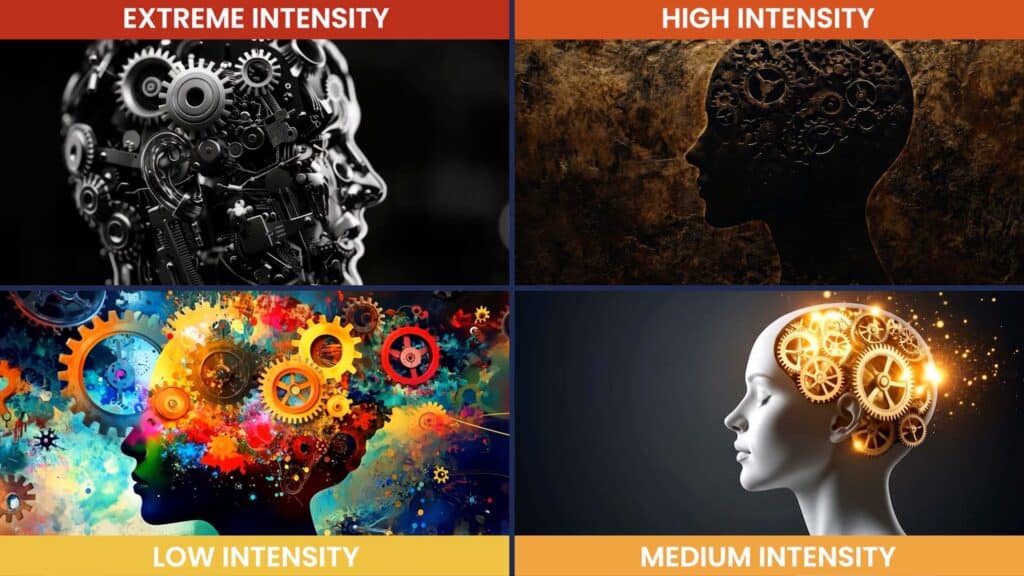
- For the extreme intensity video, I’m using gears in a robot head.
- For the high intensity video, I’m using imagery that reminds me of the Bronze Age, so it’ll be an historic issue.
- For medium intensity, I’m using golden gears that are leaving, in part, the head, and turning into vibrant bright lights.
- And for low intensity, I’m using gears that have mostly left the head – some are still in it – but there’s a multitude of bright colours that are filling, and giving me an idea of, a creative space in the head.
The Gears Are Turning: Low Intensity Emotions
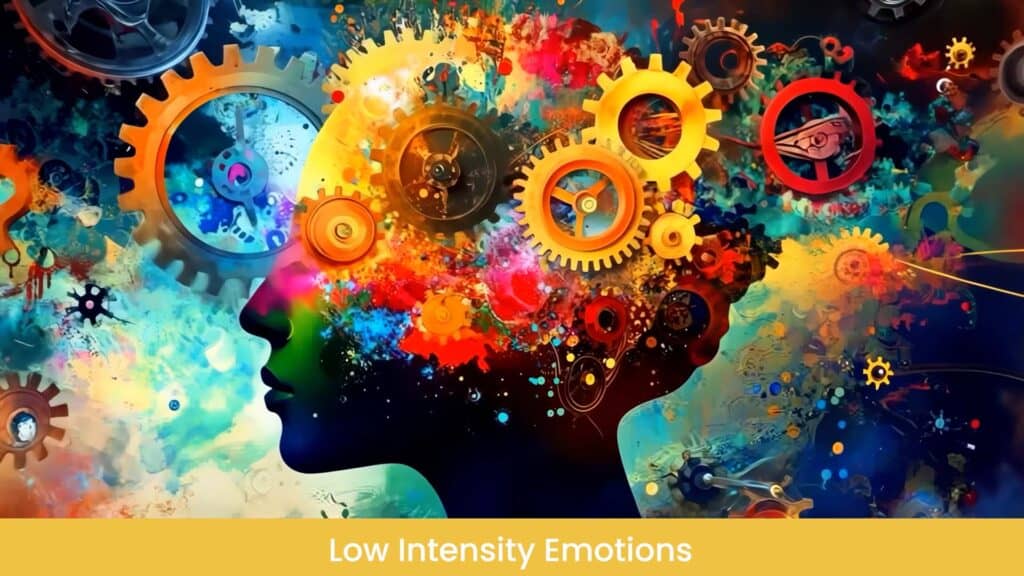
The low intensity imagery I’ve chosen, you might think, what the heck? Why on earth would I put something this complex in something that’s only a low intensity emotion? It could very easily be extreme, high, or medium, but here’s my thinking behind it. Or should I say, here’s my intuition behind it:
- Most of the gears are outside of the head.That’s a good thing – for me, it’s a good thing. I don’t want all those gears turning in my head.
- All of that colour speaks to vibrancy, it speaks to emotion, it speaks to intuition. But it’s not emotion that’s taking over my brain, because there are a lot of different splashes of colour. It’s not feeling like a dense, heavy wave, for example, that I might be drowning in.
So for me, this low intensity image speaks to potential, and intrigue, and a way of seeing the world that’s creative and bringing new change to it.
Emotions: Intensity vs Complexity In Your Imagery
Here’s where we want to differentiate between intensity of emotion, and complexity of emotion or situation. This looks like it can be very complex.
- There are a lot of gears. Most of them are disconnected. In my imagination, that’s a good thing; in yours, it might not be.
- There are a lot of colours. There’s a lot of vibrancy. There could be a lot of emotions. There could be a lot of different people involved in the decision making.
But for me, it still feels low intensity.
Identifying Emotional Intensity: It's Just A Guide
Intensity doesn’t matter when you’re transforming your emotions. I’m using it just as a guide so that you can get used to looking at your imagery, but it’s not relevant if you’re just trying to transform your emotions.
The Gears Are Turning: Transformation Example
Imagine Magnets to Remove The Gears
Focus on one step at a time. The first thing I want to do is get the rest of the gears out of the head. That feels positive to me, and it doesn’t feel like it’s going to be challenging.
The gears are flowing in and around everywhere, so I just imagine that the gears clear the head. And for me, they seem to be magnetically drawn away from the imagery altogether. And that feels healthy. I don’t need to do anything else except imagine they’re magnetically attracted elsewhere.
Fade The Coloured Paint In The Head
That leaves me with the coloured paint as my next transformation. And really, I just feel like my hand is going onto that image and drawing out a lot of that
colour – not changing the colour, but changing the density of it – and pulling it out.
It seems more intense than I want it to be, to be able to make the next healthiest decision. When I do that, I feel that the healthiest decision is group action, and that doesn’t surprise me because of the various colours of paint.
Transformation Summary So Far
- We’ve located the emotion in our head.
- The metaphor is the gears are turning, which is typically an overthinking, not a “too much emotion” metaphor. We’ve cleared the gears out of the picture.
- That leaves us with the colours. I’ve muted some of them from in the head.
- I’m recognizing this to be group action, and I want to clear the palette that surrounds the head; I want complete clarity there.
Bring In Clarity: Clear the Paint From Around The Head
I just imagine all of that paint and all of the imagery that’s around the silhouette of the head just fading away, so it’s complete clarity: There’s nothing that’s blocking us from being able to see the big picture. Unlike the extreme intensity and high intensity imagery, where I felt the head was mine, this head feels to me like group ideas.
What Does Balance Look Like To You?
I love the vibrancy of the colours because it suggests to me positive emotions and a lot of intuitive ideas. You want to trust your own imagination to bring in the right colours for balanced thinking, intuition, and emotion.
Perhaps for you, this would speak to it being happening in your head and not a group idea. Trust your own imagination, your own transformations, so that you know your next healthy step. You might find that there’s simply too much colour, it’s too confusing, and you want to remove the colour so that you can have clarity of thought.
Overthinking Can Create Stress
We’re using LDT™ to Locate, Describe & Transform™ negative emotions – or even too many positive emotions – that interfere with your decision making and your healthiest next steps. The metaphor we’re looking at is the gears are turning, and that speaks more to overthinking, not too much emotion.
But it still works through the same process, because sometimes, you need more emotion than you’re actually allowing in, or the overthinking can actually create negative emotions.
So while we’re working in the head imagery, pay attention to the rest of your body. You might find that, after you’ve located the gears in your head, you’re locating stress elsewhere in your body that you’re going to want to transform.
If that’s the case, you might still be working with geared up or gearing down metaphors, or it might be a completely different metaphor altogether.
The Gears Are Turning: Closing
The caution, with the imagery I’m using this week, is:
- Beware of robotic thought, where it’s not even your ideas that you’re putting forward.
- Beware of historic issues or historic beliefs that are coming forward, that don’t serve you anymore.
- Be aware of gears in your head that might be turning nicely, but that you just don’t need to be thinking so much, and you could allow intuition to come in.
- And finally, be aware of emotions, intuition, and thinking all being in balance.
Especially if you’re talking about group projects, extreme intensity emotions, extremely complex emotions or situations, you might need to take some private space and work through your transformations one-by-one. For low intensity emotions, for some low complexity emotions, even if they’re higher intensity, it might just take a deep breath, relax, and let the image transform quickly, while you keep going about your day.

I respectfully acknowledge that this video was recorded on the traditional territory of Mi’kmaq people.
For more information on transforming negative emotions with the Locate, Describe & Transform™ process, check out theEATprogram.com.