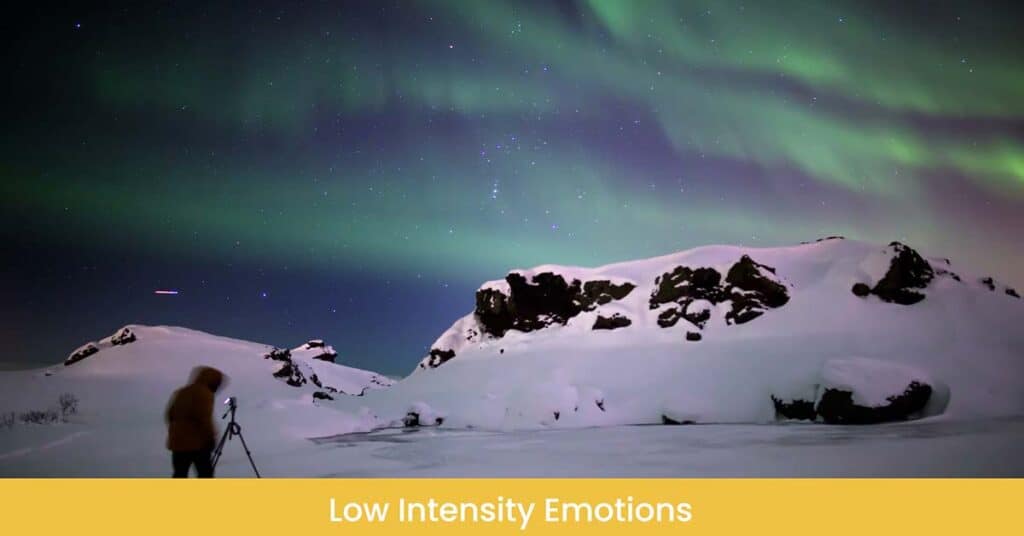
You’re loving the light show, but you’re starting to feel a little scattered. To find your guiding light, you must first take your focus off the spectacle.
Overview of Guiding Metaphors
NOTE: The introduction is the same for each of the four intensities of the Guiding Metaphors. If you have already read it, you may want to click to skip.
When you’re having emotions, do you talk about containing things? Are you erupting? Are things oozing out of you? Are your emotions overflowing? If so, you’re using container metaphors.
Maybe you see life as an expedition, or you want a tour around something. You want to take a trip down memory lane. You’re going to cruise through that stop sign. You want to explore that idea more. Let’s take a jaunt into the past. These are more vacation kinds of metaphors.
Do you use more meditative metaphors? Have you been stargazing at somebody famous? Are you guided by your imagination? Do you feel the connection toward people? Are you a dreamer?
Your emotions present as images and metaphors. Each week I explore new imagery, always looking at it from four levels of emotional intensity: extreme, high, medium, and low.
This week I’m doing it a bit differently: I’m looking at the concept of guiding metaphors, the words you use without even thinking about it, but that actually guide how you see the world. And those words create images in your mind – and in someone else’s – for how intense your emotions are.
Four Emotion Intensities with Four Guiding Metaphor Images
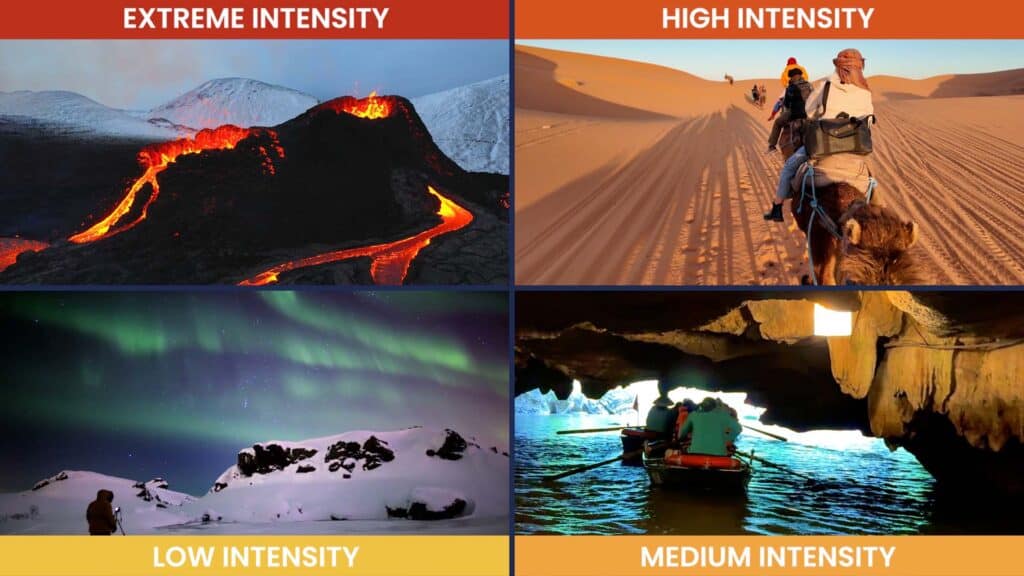
For example, if you had a smile on your face and were deeply in love, and said you were overflowing with emotions, I wouldn’t come up with this extreme intensity volcano image; however, I might come up with this image if you talked about your overflowing rage.
If we’re in high intensity negotiations, and you said “we’re in for the long haul,” I might interpret that as this image of a caravan crossing the desert. Meanwhile, you might be thinking of fifty truckers driving across the highway. We’re having the same high intensity emotions, but how we describe it is completely different.
For medium intensity emotions, we might be a married couple, and you’re saying you’re bored, we need to explore life more. But what that means to you is some version of this river cruise imagery; what it means to me is standing on top of Mount Kilimanjaro.
For low intensity emotions, you might tell me that I’m a daydreamer. The image that comes to mind for me is the aurora borealis: beautiful; enchanting. The image that comes to mind for you is disconnected and not doing my work!
Guiding Metaphors: Your Words Matter
Now, see how your emotions change when we change the wording. For extreme intensity, I talked about that volcano overflowing. But what if it’s oozing?
For high intensity emotions, is this a caravan or an odyssey? An expedition, or in for the long haul?
That medium intensity river cruise: Is it a tour? A trip? Are you exploring? Is it a jaunt?
And the aurora borealis: Are you dreaming that you’ll get there one day while the stars guiding you? Are you connected to them?
Your emotions present as images and metaphors. If you’re having negative emotions, and you want to transform your emotions, focus on your images.
- Extreme intensity emotions are going to feel wrapped up in your body.
- High intensity emotions, you’re going to be feeling a direct impact.
- Medium intensity emotions, you’ll be starting to feel the pressure.
- Low intensity emotions, you’ll be keeping things at bay.
Find Your Guiding Light: Low Intensity Emotions
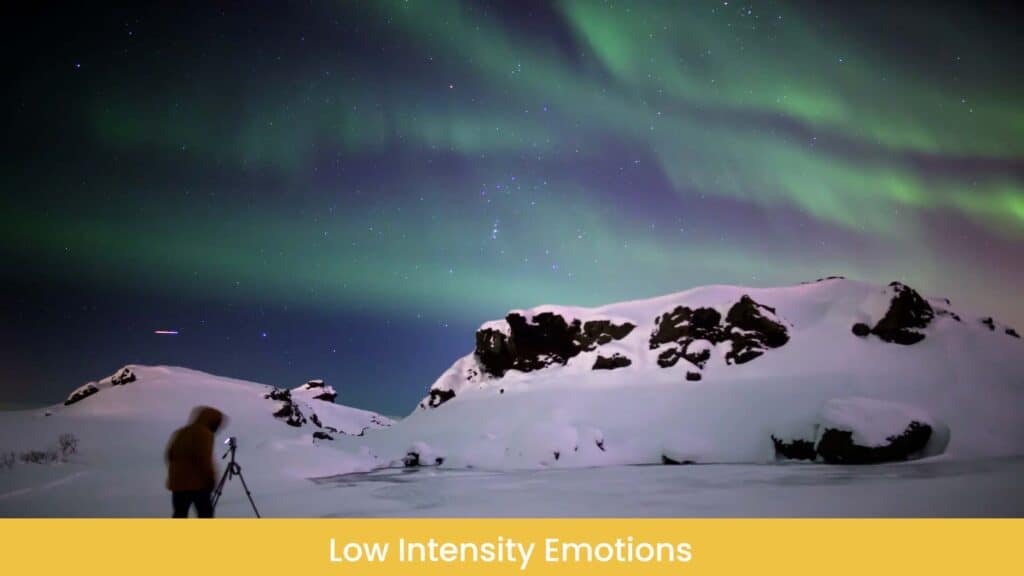
The low intensity image is the aurora borealis – the Northern Lights. And while it’s very beautiful, it also creates a low intensity stress for me. When I look at this, I see the beauty of the Northern Lights, but I also miss the individual star that I want guiding me.
This is an example of how emotions change based on a situation. Most times, I could see the beauty in this stargazing metaphor. This time, it’s a low intensity emotion for me because I’m feeling the stress of not having one particular focus.
I’m also feeling rather freezing cold and stiff in my body: That’s where I would locate it – just a general, all around stiffness – but I would also locate it as a fuzziness in my brain.
I can’t see that one singular direction that I need to go right now. It’s low intensity, so there’s not a lot of stress here: I just want some clarity.
From Scattered To Guiding Light: Transformation Example
Then, coming through the sky is a shooting star, and that’s the one I want to focus on. I want the rest of the backdrop to disappear: I want the season to change to a nice summer scene; I want to focus on just that singular star; and follow it in my imagination to where it lands. That landing point is telling me my next step.
Now, here’s what I want you to focus on when you do your transformations. As soon as I started to say I wanted to follow that shooting star, I got stomach knots. That was telling me that I don’t want to see that shooting star travelling; I want to see it standing still, guiding me.
So at that point, I back up my transformation. I stopped seeing the shooting star trying to take me to a destination, and I see it sparkling in one place. And that transformation tells me that I’m already where I’m supposed to be. I don’t need to go somewhere else. I just need to keep looking at that one singular star.
I’m in the right place with that transformation. My body completely relaxes, and I’m able to look inward, and say, “What am I doing right now?” That’s what I want to continue doing.
Your transformation could be completely different. Locate it in your body; Describe what focuses you in this image; and Transform it to take your next healthiest step.
Guiding Metaphors: Closing
That’s a quick look at the concept of guiding metaphors. You can learn more – there’s a full chapter on them in my book, Emotion Commotion. The key point is that the words you use matter. They tell you what your emotions are, and if they’re positive or negative. If you go to the next step and describe the imagery that those words bring up, you’ll get a lot more insight into your emotions.
You’ll also learn that the same words bring up different imagery and different intensities of emotions for somebody else than they do for you. And that can give you a starting place for better conversations.