
When it comes to life balance, this high wire balancing act gives me a thrill, but if you long for a little less adventure, begin by transforming your emotions.
Overview of The Emotions Metaphor "Balancing Act"
NOTE: The introduction is the same for each of the four intensities of the Balancing Act metaphor. If you have already read it, you may want to click to skip.
Hello, my name is Karen and, in this series, I help you Locate, Describe & Transform™ (LDT™) the emotions that interfere with you making your best decisions. Each week I explore a new metaphor. If you want more details on my process, check out the short process video.
This week’s metaphor is BALANCING ACT, which I think is something we can all relate to.
Four Emotion Intensities with Four Balancing Act Images
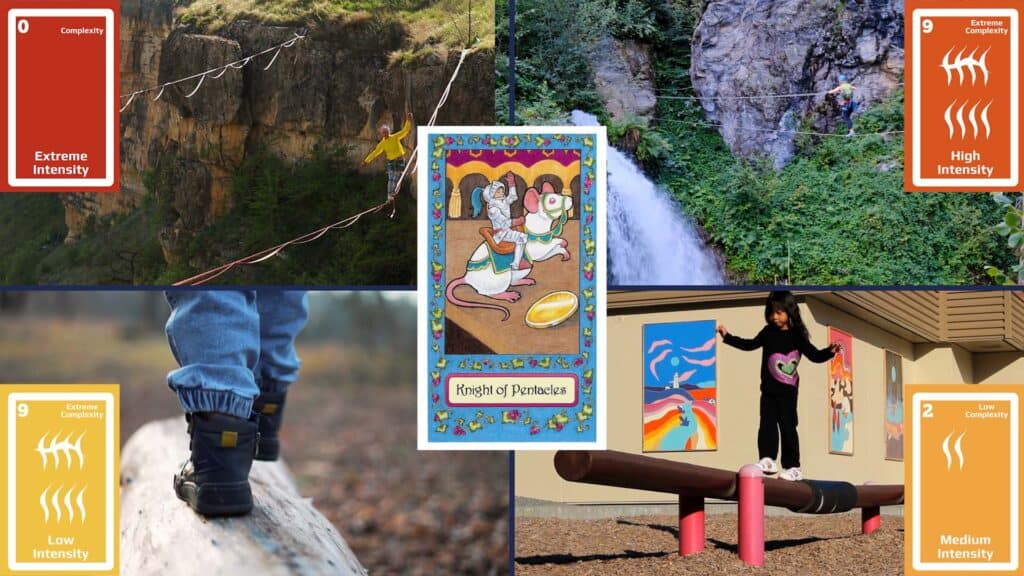
- For extreme intensity emotions, I chose a very flexible wire high up on canyon walls with the person crossing, not holding on to anything with their hands, although they do have a security rope around them.
- For high intensity, I chose a more stable cable wire with somebody using their hands on other cables to walk across the chasm.
- For medium intensity, I chose a series of connected logs on a child’s playground that are only a couple of feet off the ground, but that move as you walk on them.
- And for low intensity, I chose a log that is solid right on the ground.
As always, a reminder: If you connect with the balancing act metaphor, but your imagery is completely different, consider closing your eyes, working with your own imagery to Locate, Describe & Transform™ your negative emotions.
The Complexity Cards
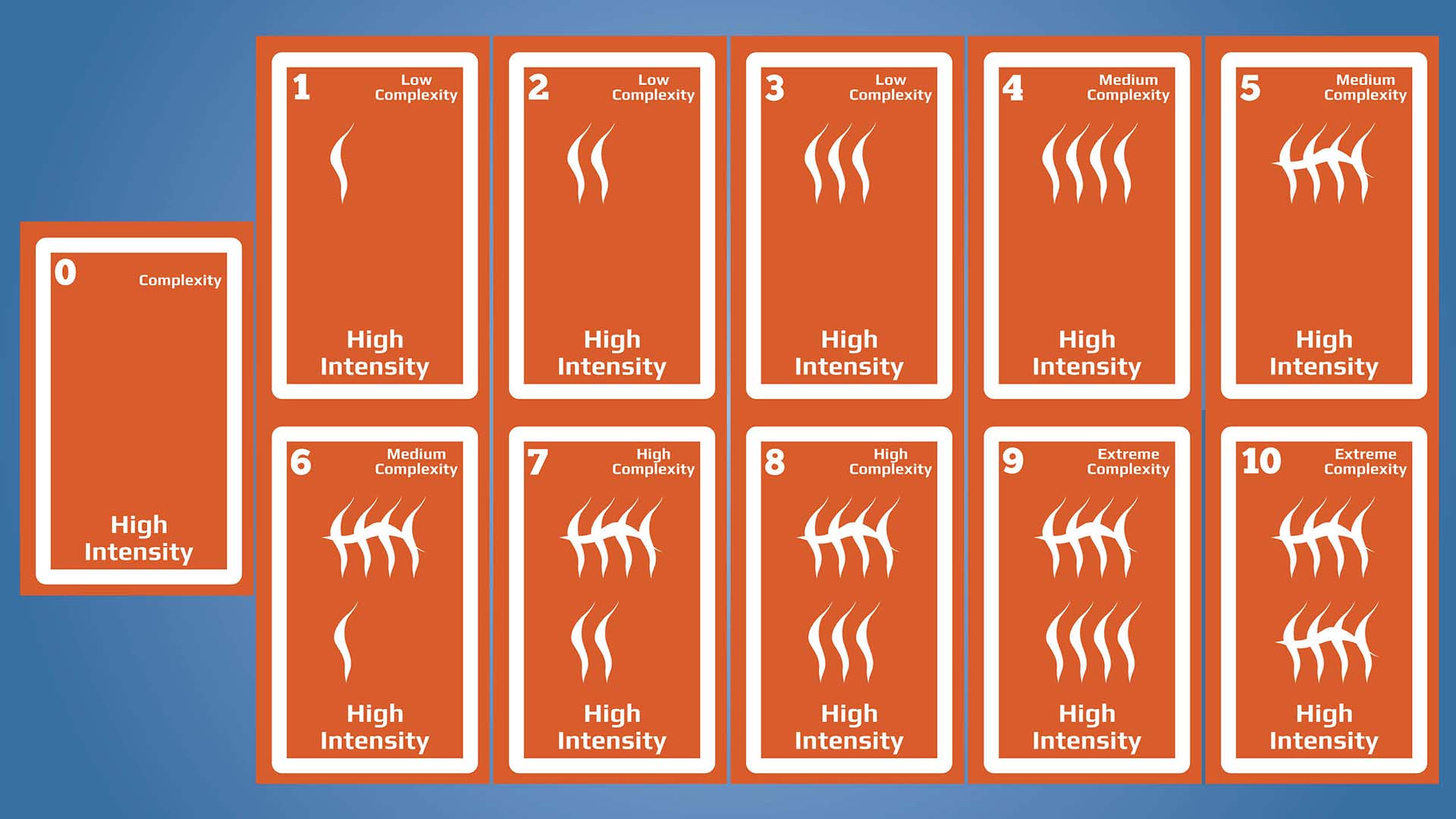
For each of the emotional intensities, there’s a complexity card:
- For extreme intensity, the complexity is zero. That means whatever the situation, whatever your emotions, it involves only you and only one particular aspect of something.
- For high intensity, it’s actually extreme complexity.
- For medium intensity, it’s a low complexity card.
- And for low intensity, it’s an extreme complexity card.
Tom Thumb: The Character from The Whimsical Tarot Deck
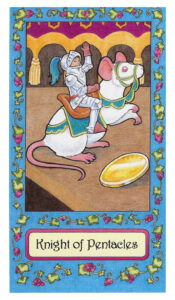
In the centre of the layout is a Whimsical Tarot card: the fairy tale is Tom Thumb; the tarot card itself is the Knight of Pentacles. Now, Tom Thumb is a bit before my time, but I do remember my grandparents telling me that story. Tom Thumb is shown riding on his mouse as part of King Arthur’s Knight of the Round Table on the tarot card, and the origin of the story is a wish from a fairy queen grants a poor couple a son as small as a thumb. The child is courageous, clever, and resourceful at overcoming real world limitations.
In Tom’s case, it’s physical; the Knight of Pentacles generally is speaking toward your finances. So we’re going to be looking at the balancing act with respect to your financial situation, looking towards balancing well-researched plans to get the results that you desire; taking a moment to look at the big picture, but then carefully checking every detail. That’s what’s going to bring you into balance.
So, as we explore the imagery and the complexity cards, consider a practical plan for bringing balance to your finances and or specific projects you might have in mind.
Balancing Act: High Intensity Emotions
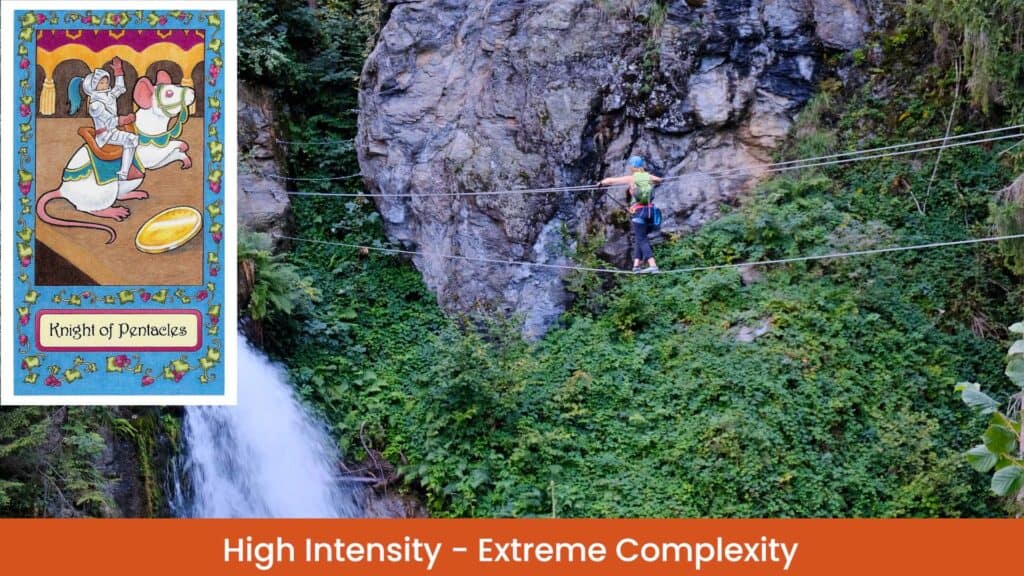
The high intensity video I chose is somebody walking across a cable with the ability to hold on to two other cables, one in each hand. The structure looks solid enough, and the person looks relatively secure, but they are high up off the ground, approaching a waterfall. The extreme complexity speaks to other people, other aspects of the situation that you need to bring into balance.
Now, this is pretty interesting for me to give an example of a transformation, when in fact I wouldn’t transform this image. I feel alive with the high intensity, with the security of holding on to the cables; I’m looking forward to crossing this bridge. Unlike the extreme intensity where I wouldn’t do that activity, I would absolutely do this activity, and have done similar.
Not Every Emotion Needs A Transformation!
It does make it clear that just because you’re having high intensity emotions doesn’t mean they’re negative emotions. It doesn’t mean you should stop doing what you’re doing; it just means you need to stay alert.
So for me, I have a big grin on my face, but I’m taking it step-by-step. I’m holding on – I’m not going to be freewheeling and letting go of my hands – and I’m going to be looking toward my destination. I feel like this is the healthiest of me being in balance: There’s enough excitement, but there’s also enough grounding.
What's Your Balancing Act?
For you, however, if the high intensity emotion is a fear, you don’t want to be in this situation. You want to locate that emotion in your body:
- You might have your heart beating really strongly.
- You might have your throat closed up out of fear.
- You might be gripping on to the cables.
- You might your feet unable to move.
Any of these. That’s what you want to focus on, to Locate your emotion, Describe that tension using this imagery, if that works for you, and then Transform it.
In other words, what’s your healthiest way to imagine yourself not on this cable right now?
- Maybe you just imagine yourself walking off as quickly and safely as possible, getting yourself to solid ground and rethinking your plan.
- Maybe you need a helicopter rescue, where somebody comes down and takes you.
If that’s the case, if that seems healthy to you to imagine, then that means there is an escape route with the assistance of somebody else, whether it’s a financial planner or somebody who you partner with. But there’s somebody else you can be working with to create that stability.
So transform the image until you feel in a healthy, peaceful place. That’s the place where you’re now going to make your best decisions about bringing balance to your finances or your projects.
Closing
Last week, we looked at the leaning metaphor, and the caution within that was: Be careful, you might be leaning toward or away from something and not really noticing, and that the best position would be for you to straighten yourself up. This time, we’re looking at a balancing act metaphor, and I think the caution here is to recognize that balance does not mean equal distribution of everything all the time. Each of us finds our own balance.
So for me, surprisingly, once I started going through the process myself with each of these images as an example for you, I found that my healthiest balancing place was at the high intensity emotions. For you, it might not be: low intensity might be exactly where you want to be. But I found, for me, high intensity did not mean negative emotions, and that my healthy balance is a bit more toward adventure than it is toward security.
The focus, however, is still about being in balance, not putting one so far ahead of the other, so you’re clinging to security and not willing to go out and try anything new, versus you’re always flying by the seat of your pants, and you have zero security.
You will know that you are out of balance when you start to feel uneasy or discomfort in some part of your body.
I respectfully acknowledge that this video was recorded on the traditional territory of Mi’kmaq people.
For more information on transforming negative emotions with the LDT™ process – Locate, Describe & Transform – check out theEATprogram.com.